

French Court Electronic Signature Evidence: What Judges Demand (2024-2026)
In the digital age, an electronic signature often feels like a definitive act. However, recent jurisprudence from French courts reveals a more nuanced reality: a simple ‘signed’ PDF is frequently insufficient when challenged. This article details the specific technical and evidentiary requirements judges demand for a legally robust electronic signature in France, based on 2024-2026 rulings, moving beyond a mere visual mark to a comprehensive, verifiable evidence file.
The Evolving Landscape of Electronic Signature Evidence in France (2024-2026)
The legal framework for electronic signatures in France, primarily governed by Articles 1366 and 1367 of the Civil Code and supplemented by the eIDAS Regulation (EU) No 910/2014, sets out the conditions for their legal validity. Recent court decisions, particularly from 2024 to 2026, have provided crucial clarifications on what constitutes admissible and robust evidence when a signature is contested.
Understanding eIDAS Signature Levels and Evidentiary Weight
eIDAS defines three levels of electronic signatures: Simple Electronic Signature (SES), Advanced Electronic Signature (AdES), and Qualified Electronic Signature (QES). A critical distinction for legal proceedings is that only a QES benefits from a presumption of reliability under Article 1367 al. 2 of the French Civil Code. This presumption significantly shifts the burden of proof, making a QES exceptionally robust in court. For SES and AdES, the party relying on the signature must proactively demonstrate the reliability of the entire signature process if it is challenged.
To ensure a QES is truly qualified, it must be issued by a Qualified Trust Service Provider (QTSP) that is included in the EU Trusted List Browser, which aggregates national lists like France’s ANSSI list. This qualification requires rigorous audits of security, identity verification, certificate management, and business continuity plans.
Beyond the Signed PDF: Key Jurisprudence Insights (2024-2026)
Recent French court rulings unequivocally demonstrate that merely presenting a document with a visual ‘signature’ or a basic technical certificate is insufficient. Judges now consistently demand a comprehensive, intelligible evidence file that reconstructs the entire signature event.
Scanned Signatures vs. Electronic Signatures
A fundamental distinction clarified by the Cour de cassation (Cass. com., 13 mars 2024, n° 22-16.487) is that a scanned image of a signature is not an electronic signature in the sense of Article 1367 al. 2 of the Civil Code. This means it does not benefit from any presumption of reliability. In such cases, the party relying on the scanned signature must prove the signatory’s consent and identity by other means, a significantly higher evidentiary bar.
The Insufficiency of a Bare “Signed Electronically” Mention
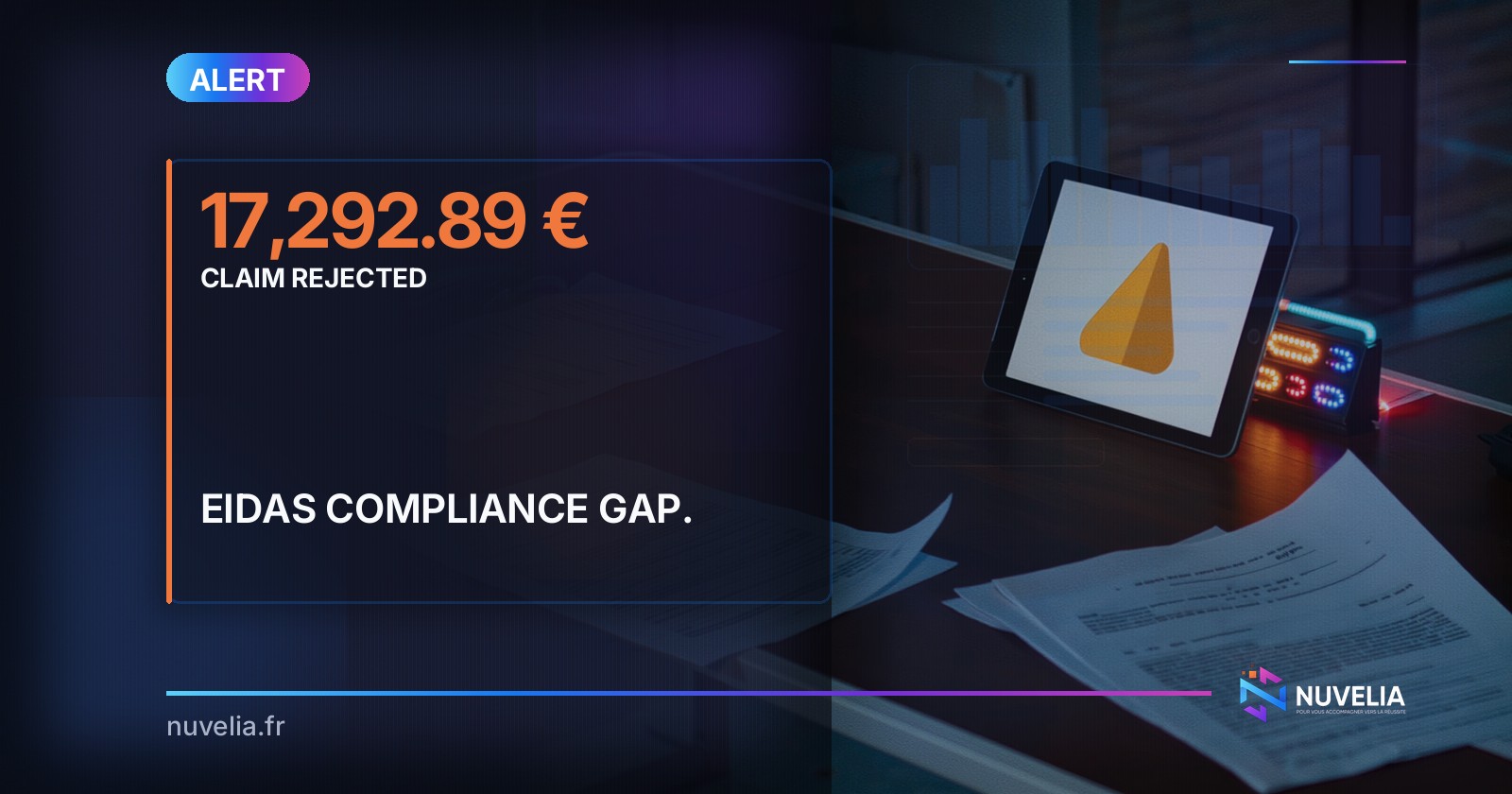
Multiple appellate court decisions in 2025 converged on a crucial point: the simple mention “signed electronically” at the bottom of a document is not enough to establish its reality or opposability. The Cour d’appel de Riom (19 mars 2025, RG 24/00497) rejected a 17,292.89 € claim due to the absence of a reliability attestation and insufficient proof of signatory identity. Similarly, the Cour d’appel de Paris (3 avril 2025, RG 23/19316) ruled that a limited production of evidence, restricted to this mention, was inadequate.
The Cour d’appel de Douai (27 mars 2025, RG 22/05040 & 22/05041) reinforced this, stating that while technical certificates might be present, they were insufficient to identify the signatory with certainty. A judge requires a clear, readable link between the certificate, the individual’s identity, and their entire signature journey. Furthermore, the Cour d’appel de Rouen (10 avril 2025, RG 24/01774) highlighted that merely submitting a raw dump of technical data is not enough; the evidence must be comprehensible and exploitable by the judge, not just a mass of uninterpreted information.
The Critical Role of Qualified Electronic Signatures (QES)
The Cour de cassation (3e civ., 5 mars 2026, n° 24-21.034) explicitly recalled that the presumption of reliability only applies to a QES. Lower courts are now required to qualify the signature process before applying this presumption. This means that if a QES is not used, the burden of proving the reliability of the process and the imputability of the signature rests entirely on the claimant.
The Cour d’appel de Versailles (29 avril 2025, RG 24/04372) further illustrated this by rejecting a bank’s claim because an internal attestation of proof, emanating from within the banking group, was deemed insufficient to characterize a QES and benefit from its presumption. The judge explicitly required justification of a qualified electronic signature certificate meeting the requirements of Article 28 of eIDAS. This underscores the necessity of relying on an independent, qualified third party. For more insights into integrating these advanced solutions, consult Nuvelia’s guide on electronic signature integration.
Constructing a Robust Electronic Evidence File: The “Proof Chain”
A legally sound electronic signature relies on a meticulously constructed “proof chain” that documents every step from identity verification to long-term archiving. This comprehensive approach is essential for demonstrating the signature’s integrity and imputability in a court of law.
Key Elements of the Proof Chain
- Identity Verification (IDV): The process that establishes a robust link between the physical person and their electronic identity. For QES, this often involves a Personal Identity Verification (PVID) process, which might include video identification or biometric checks.
- Authentication & Consent: Evidence that the signatory authenticated themselves to the system (e.g., via multi-factor authentication) and explicitly consented to the document’s content and the act of signing.
- Scellement (Sealing) & Horodatage (Timestamping): Technical measures to ensure the integrity of the document after it has been signed and to establish an undeniable date and time of signature. Qualified timestamping, as per Article 41 of eIDAS, provides a presumption of accuracy.
- Certificate: The digital certificate that cryptographically binds the signature to the signatory. For QES, this must be a qualified certificate issued by a QTSP.
- Evidence File (Dossier de Preuve): A comprehensive, structured, and human-readable record of the entire signature process. This file must detail the steps taken, the identities involved, and the technical data generated, in a format that a judge can easily understand and exploit. Cases like the Cour d’appel d’Amiens (24 avril 2025, RG 23/04010), where a bank’s ~20,000 € claim was rejected due to insufficient links between the evidence file and the disputed contract, highlight its importance.
- Conservation & Restitution: The ability to securely store the signed document and its associated evidence file for the required legal retention periods (often 5-10 years or more) and to reproduce them in an intelligible format upon judicial request.
Integration Pitfalls and How to Avoid Them
Integrating electronic signature solutions involves specific risks that can compromise the proof chain. Common issues include webhook loss, where critical event notifications for signature completion or status changes are not received, necessitating robust reconciliation polling mechanisms. Identity verification failures, where the PVID process does not complete successfully or the identity document is rejected, directly prevent signature issuance. Documents rejected at upload due to incorrect format or content issues, and expired signature requests where the signatory fails to complete the process within the allotted time, also break the chain. These integration considerations are equally crucial for robust banking payment solutions integration, where compliance and reliability are paramount.
For instance, in the context of the French e-invoicing reform 2026, ensuring a qualified signature is valid and its evidence accessible is vital for tax compliance and avoiding financial penalties.
Unsure which electronic signature solution fits your context?
We help you compare providers, verify eIDAS constraints, and scope the technical integration before you commit.
The Future of Evidence: Qualified Electronic Archiving (QEA)
With the advent of eIDAS 2 (Regulation (EU) 2024/1183), Qualified Electronic Archiving (QEA) is set to become a standalone qualified trust service. This development is crucial for ensuring the long-term probative value and integrity of electronically signed documents, especially those requiring extended retention.
eIDAS 2 and CEN/TS 18170:2025
The implementing act 2025/2532 integrates the CEN/TS 18170:2025 standard as a primary reference for functional requirements, drawing on the OAIS (Open Archival Information System) model’s SIP/AIP/DIP cycles. This is combined with ETSI EN 319 401 for provider governance. This new European framework harmonizes archiving standards, superseding national norms like AFNOR NF Z 42-013 in France and ensuring consistent cross-border recognition of archival probative value.
Key requirements for QEA include an immutable audit trail and automated integrity reports provided to users. Certification by an accredited body (such as LSTI in France) is a prerequisite for a provider’s inclusion on the EU Trust List. The upcoming EUDI Wallet, anticipated before 2027, will further streamline identity verification processes, directly impacting QES workflows for relying parties. More details on this can be found in our article on the EUDI Wallet for E-Signature Relying Parties: Integration Roadmap Before 2027.
Navigating Legal Nuances and Data Protection
Beyond technical implementation, integrators, architects, and CTOs must grasp the broader legal context and data protection implications inherent in electronic signature processes.
Legal Scope and Proof Conventions
It is important to note that certain acts remain outside the scope of electronic signatures or require specific formalities. These include acts under private signature related to family law and successions, or personal guarantees outside professional needs, as stipulated by Article 1175 of the French Civil Code. Workflow designers must carefully map these exclusions.
For international contracts, eIDAS applies only within the EU/EEE. Other jurisdictions have different legal frameworks (e.g., UK eIDAS post-Brexit, ZertES in Switzerland, ESIGN Act/UETA in the USA). For cross-border agreements, a contractual clause known as a “convention de preuve” (proof convention) is almost indispensable. This clause explicitly states that parties accept the electronic signature process and its associated evidence as valid and binding. Furthermore, it’s crucial to distinguish the simple date of signature from the legally opposable date provided by qualified timestamping (Art. 41 eIDAS), which offers a presumption of exactness.
GDPR and Identity Data Management
The Personal Identity Verification (PVID) process, particularly for QES, involves collecting sensitive data such as identity documents, video recordings, and biometrics. This necessitates a thorough Data Protection Impact Assessment (DPIA), a Data Processing Agreement (DPA) with the QTSP, and transparent information for the signatory regarding their data rights.
Data retention policies are complex: the signed document itself has a business-defined duration, the evidence file is subject to prescription periods (often 5-10 years), and identification data must be retained according to the QTSP’s regulatory obligations (potentially 7-15 years). These distinct durations must be meticulously mapped in the organization’s register of processing activities. Auditing the QTSP’s data localization and any sub-processors involved in the PVID chain is also essential for GDPR compliance. These considerations mirror the stringent data handling requirements found in payment integrations, especially with emerging regulations like Verification of Payee, as explored in Verification of Payee and Instant Credit Transfers: Mastering PSP Integration Pitfalls.
Frequently asked questions
What is the primary difference in evidentiary weight between an SES/AdES and a QES in French courts?
In French courts, a Qualified Electronic Signature (QES) benefits from a legal presumption of reliability under Article 1367 al. 2 of the Civil Code. This means the burden of proof shifts to the party challenging the QES. For Simple (SES) and Advanced (AdES) Electronic Signatures, the party relying on the signature must prove its reliability and imputability if contested.
What constitutes a sufficient “evidence file” for an electronic signature in a French court?
A sufficient evidence file goes beyond the signed PDF. It must be a comprehensive, structured, and human-readable record that documents the entire signature process. This includes proof of identity verification, explicit consent, authentication steps, technical data (like certificates and timestamps), and an auditable trail linking the signatory to the document and the signature event. Raw technical data dumps or internal attestations are generally deemed insufficient.
How does eIDAS 2 impact the long-term preservation of electronically signed documents?
eIDAS 2 introduces Qualified Electronic Archiving (QEA) as a new qualified trust service, integrating standards like CEN/TS 18170:2025. This harmonizes requirements for long-term preservation across Europe, ensuring the probative value of archived electronic documents. It mandates immutable audit trails and certified providers, moving beyond national standards like AFNOR NF Z 42-013 to offer cross-border recognition.
Read next